

How To Draw Da Vinci Shapes
Leonardo Da Vinci Drawings:
5 Lessons from the Renaissance Master
Leonardo da Vinci drawings were but a few of his many contributions during his lifetime.
Frequently touted as having been 1 of the greatest minds of the Renaissance, he was a renowned painter, sculptor, architect, engineer, scientist and inventor.
(His inventions include the predecessor to the modernistic day helicopter, parachute, armoured automobile, self-propelled cart, and many more!)
Da Vinci likewise studied nature, anatomy, physics, mechanics and weaponry.
Of course, here at The Cartoon Source nosotros are nearly enthralled by his drawings, in which he was masterful in far more than than technical skill.
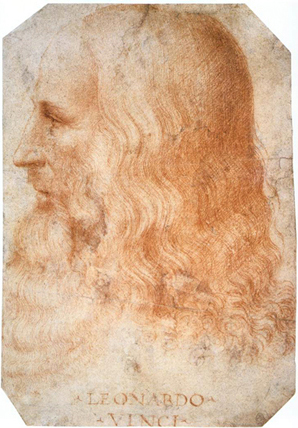 Portrait of Leonardo past Francesco Melzi
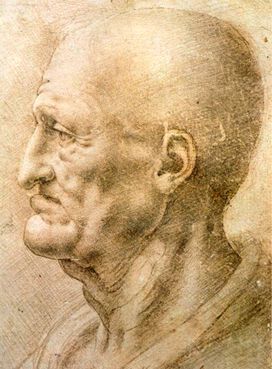
He had a souvenir for capturing distinct characters in his portraits.
James Beck, an art historian at Columbia University, once commented on the Mona Lisa:
"It is the inherent spirituality of the homo animal that Leonardo was able to ingenuine to the picture show that raises the human figure to some kind of majesty."
Perhaps that is why we are yet in awe of Leonardo da Vinci drawings 500 years after their creation.

So what tin can nosotros larn from Leonardo da Vinci drawings?
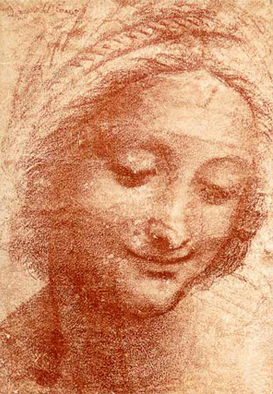
He was a master of simplification.
This does not mean that his drawings were elementary! Just the opposite.
Simplifying tin ironically be one of the nigh difficult aspects of drawing.
To simplify, an creative person must know what data is essential to include in their drawing, and what to leave out in social club to strengthen information technology.
Leonardo da Vinci drawings are a perfect instance of this. He was very selective, and in that location is nothing excess or unnecessary in his drawings.
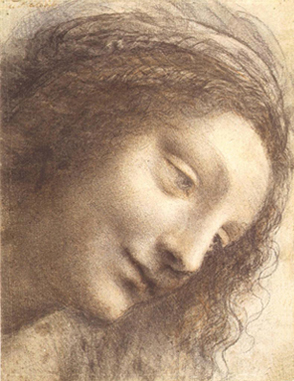
For example, look how simply the shadow shape on the neck is drawn.
There are only a few delicate value shifts to signal the subtle turn of the form, and the separation between the caput and neck.
If more than detail had been included in the shadow, it would attract our attention and distract from the focal signal of the image: the face.
Lesson #1:
Mayhap during our next cartoon session, instead of wondering what to include, we can enquire ourselves: "What should I leave out of my drawing?"
Leonardo used dark values and sharp lines sparingly.
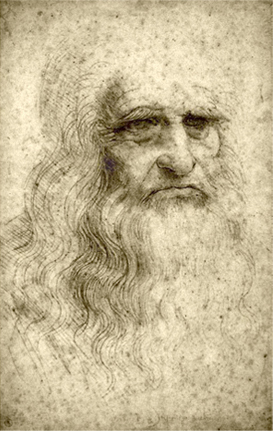
Many Leonardo da Vinci portrait drawings are mid-range (or middle key) on the value calibration.
This means that he drew generally with values 3 to vii, using the extremes (pure white and pitch black) just as carefully considered accents.
(Granted, nosotros practice non know how much darker these drawings may accept been originally.
They must have faded considerably over the by 500 years or so!)
Just fifty-fifty if this was not the intended consequence, look at the dream-like quality that information technology creates in this and the next Leonardo portrait drawing. The images almost look like memories. Why not consider using this effect in your drawings?
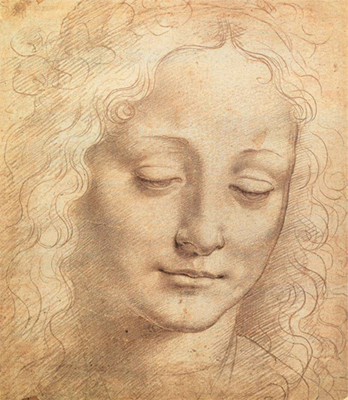
Da Vinci was besides very selective when using sharp lines. For example, in the drawing in a higher place he used dark, precipitous lines only to accent and bring depth to the features of the confront (the eyes, olfactory organ and mouth). Especially because these accents contrast the softness of the remainder of the cartoon, they finer bring our attention to the focal points: the features of the face.
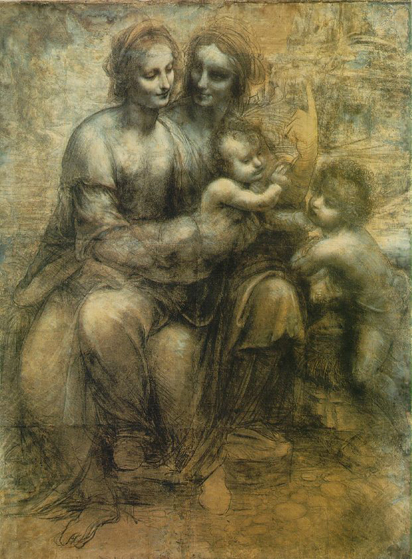
There is a sense of move in Leonardo da Vinci drawings.
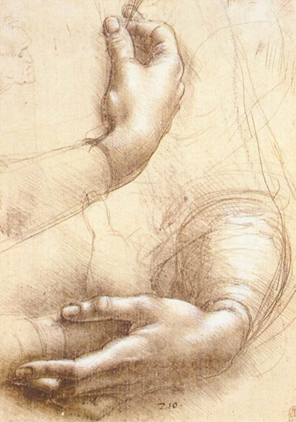
Even his drawings of models in stationary poses feel organic and lively!
One of the reasons for this is the gestural quality of his lines.
Nosotros can often encounter remnants of gesture lines with which he began his drawings.
They seamlessly go a role of the concluding image, adding dynamic movement and interesting compositional elements to the picture.
They likewise provide a kind of glimpse into Da Vinci's thought process.
Nosotros can nearly see him searching for rhythms and forms as he pulls them out of the paper.
What nosotros can learn: Oftentimes the longer and more detailed our drawings are, the greater the tendency for them to "stiffen up" and become static.
We tin remedy this by paying attending to gesture and rhythms throughout our drawing. Furthermore, if we exaggerate the gesture slightly in the beginning, then even when we "tighten up" our drawings equally we add more detail, the image will retain some of that original movement.
Speaking of exaggeration...
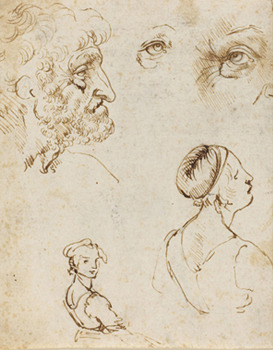
Da Vinci used exaggeration to add together character to his drawings.
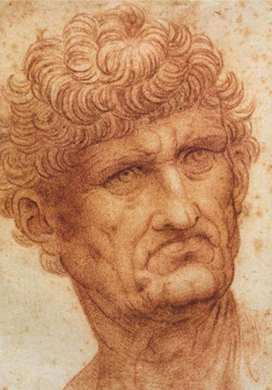
Non all of his subjects are fatigued naturalistically (how they would appear in life).
Perhaps because of the way he exaggerated certain qualities of the portraits, information technology looks as if some of his subjects existed somewhere between dreams and reality.
Even so, this slight caricaturization adds a great deal of character to the drawing.
I am reminded of a quote by Russian portraitist Valentin Serov, who in one case said:
"Whatever homo face is so complex then unique that y'all can always discover in it various traits that are worth portraying, exist they good or bad."
He continued, "For my function, each time I appraise a person'south confront, I am inspired, you might even say carried away, not past his or her outer attribute, which is oft niggling, but by the characterization it can be given on canvas."
"That is why I am defendant sometimes of having my portraits look like caricatures."
I run across this quality in Leonardo da Vinci drawings as well and very much savour information technology.
Peradventure during our next drawing session, we tin ask ourselves: What tin I slightly exaggerate in order to enhance the character of my drawing?
Leonardo constantly drew studies.
He recorded his observations and inventions in 13,000 pages of drawings and notes! Looking at these sketches, you tin can see his incredible desire to truly understand what he was looking at and cartoon. The next time we are about to jump into a new cartoon, peradventure it would do good united states to first draw a few studies of our own!
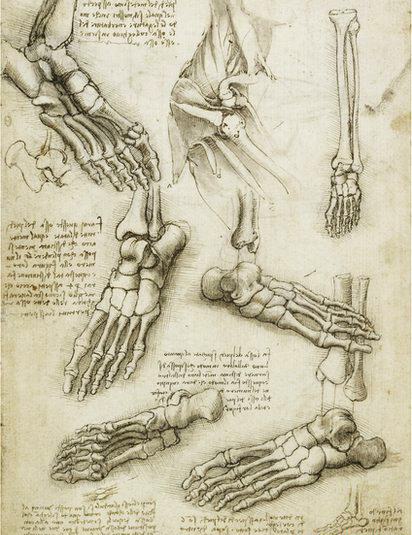
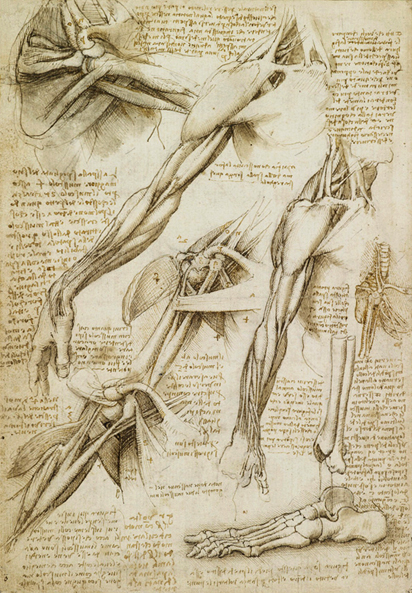
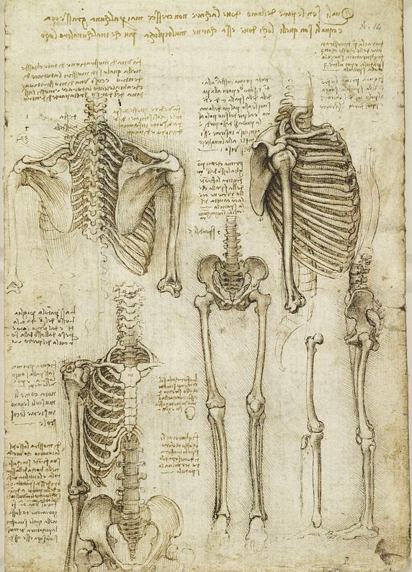
These are but a few of the countless lessons we can learn from Leonardo da Vinci drawings. We haven't even begun to talk about his compositions... But we'll leave that for another article!

If you enjoyed these Leonardo da Vinci Drawings,
you may also be interested in ...
Render to Inspirational Drawings from Leonardo da Vinci Drawings
Return to the Home Page from Leonardo da Vinci Drawings

Source: https://www.thedrawingsource.com/leonardo-da-vinci-drawings.html
Posted by: kennedyuted1981.blogspot.com
0 Response to "How To Draw Da Vinci Shapes"
Post a Comment